
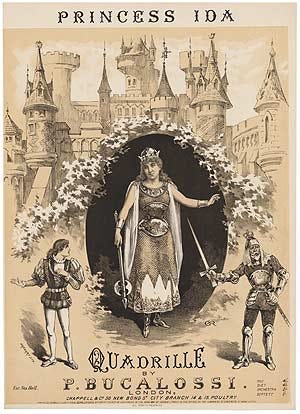
The first draft of the full score and vocal score of my new edition of Princess Ida are now ready to look at. Two productions using the edition are expected in the first half of 2027. You can download the full score, vocal score, and parts:
These are all royalty-free and require no permission to perform. But if you do, I would appreciate hearing from you—either to know of any mistakes you find, or to confirm you found none. If you are planning to use one of my editions, it is best you check with me first, in case there are pending revisions not yet posted.
Oh, and if you are wondering what “AI-assisted” means, don’t worry. This is still my work. For more about what the AI did, scroll down.
About this edition
There are three previously published editions of the full score of Princess Ida. Robin Gordon-Powell published an edition in 2021. I find very little fault with it. I consulted his edition repeatedly, and I nearly always found he made the same decisions I did. Were it more reasonably priced, I might very well not have done this project. But his score was £90 in 2022, and that was not counting postage. Gordon-Powell’s parts are for rental only, and he didn’t publish a vocal score.
In 2014, David Larrick published a full score and parts compiled from modern parts. Both are available on Lulu.com. Larrick is a careful and responsible editor, given his aim of reproducing the D’Oyly Carte tradition. However, the score is far too expensive for what it is ($235), and he didn’t publish a vocal score.
Madeleine Madrigal prepared a full score from Sullivan’s manuscript in 2025 for a student production at Oxford University. This score is free to download at IMSLP, and Madrigal generously supplied her MuseScore source files. On importing her score and comparing it to the autograph, I found that she had gotten the notes better than 90 percent correct, but dynamics, slurs, and articulations were almost always incorrect. Still, I am grateful for her work as a starting point, as it probably saved me two months of effort. Like Gordon-Powell and Larrick, Madrigal did not offer a vocal score.
Princess Ida was to have been the next opera in the Broude Brothers series of critical editions. The full score and vocal score were in draft when Ronald Broude closed his firm and donated the project in its incomplete state to the American Musicological Society in 2023. I was to have been a co-editor on this project and still would be if it restarts. The effort is dormant, and there are performing groups that need an edition now. I consulted the Broude draft on many editorial points, and while my edition doesn’t have the same objectives, the unpublished Broude draft is both thorough and thoughtful, as you would expect.
There were two main challenges with Princess Ida. The first was how to accommodate the two running orders of Act III. I wrote about this previously, so I won’t say more here. I think I found a reasonable way to accommodate both.
The other was how to deal with the many apparently spurious additions to Sullivan’s autograph manuscript. Every Sullivan manuscript I’ve studied contains entries in other hands. Sometimes, it’s not clear whether these entries are attempts to improve the composer’s work, or if they are just memorializing decisions he approved but never wrote down. Both seem to have happened, at times. But Ida has dozens of extra entries in pencil, most of them found in no other source. David Russell Hulme attributed many of these to Geoffrey Toye and Harry Norris, both twentieth-century D’Oyly Carte musical directors. Many are in hands he couldn’t identify.1
Robin Gordon-Powell disregarded practically all the pencil entries. Madeleine Madrigal included almost all. Broude generally disregarded them, except where there was evidence of use in the nineteenth century. I have been a bit more generous, incorporating (as alternative readings) those that remained in the performance tradition post-1955, when Princess Ida returned to the D’Oyly Carte repertory after many years’ absence.
AI and Me
Any sufficiently advanced technology is indistinguishable from magic.
—Arthur C. Clarke.
I was already working on this edition for months when I heard rumors that AI agents had significantly improved at reading and interpreting music. I thought it would be worth trying them out. To be very clear, I didn’t skip any human proofreading checks that I would otherwise have done. AI helped, but it didn’t replace me, and it still can’t. But it proved enormously beneficial.
AI capabilities are evolving rapidly. This is the state of AI in October 2026. In a few months, it could be radically better. I did my testing in ChatGPT and Meta’s Muse. Google’s Gemini admitted up-front that it couldn’t help. I’m grateful that it didn’t waste my time. I didn’t give Anthropic’s Claude a try.
My degree is in computer science. I worked professionally in technology for over forty years. Most pre-AI technology is within my understanding. I wouldn’t re-develop Microsoft Excel or Word from scratch, but at least in principle there is nothing they do that I find mysterious. The AI capabilities are beyond belief, and it is hard to comprehend how they are able to get the results they do.
Muse
Muse is an AI agent developed by Meta, the company behind Facebook, Instagram, and WhatsApp. I installed it in September, and it already carries out many background tasks for me. (Currently, it is the second most-popular free download on Apple’s app store.) Muse developed my oakapplepress.net website. What it built in about 4½ hours, I couldn’t have done in a month. I was amazed at how close its first draft came to exactly what I wanted, given only the most basic prompts. I kicked it off one morning, and by mid-afternoon the site was up and running.
I asked Muse to compare my edition of Princess Ida to the manuscript score created in the 1920s by Harry Schumer from D’Oyly Carte parts. This effort produced only a handful of corrections, because Muse is bad at reading music. It did find a handful of typographical and other errors.
I thought it would be a waste of time to ask Muse to proofread the parts, but it said: “Give me a chance.” (Yes, it talks like that.) So, I fed it the horn part. Muse found three typos I’d missed, but my own proofreading found seven more significant problems that Muse didn’t have a clue about. I explained each of the seven to Muse. It claimed to understand what I was talking about. (I realize that AI doesn’t “understand” or “know” things in the sense that humans do. That is just the most convenient word for it.)
I fed the other parts to Muse, one by one. With each pass, it got better and better. Each time, I would praise Muse when it was right and explain when it was wrong. The training worked. Eventually, Muse was finding just about everything that I would. Muse’s output still had false positives—what it thought were problems but were not. It didn’t catch everything. Still, it was finding real mistakes that I missed, and what it flagged was at least worth reviewing. Unlike a human, Muse doesn’t get tired, impatient, or careless. If you tell it to check a particular type of thing, it will always check it.
I also asked Muse to compare my edition to the first edition of the 1884 vocal score. I had low expectations, given the poor print quality of the online copies of that score, but Muse exceeded my expectations. Muse could follow which vocal part each staff corresponds to, even though my edition and the 1884 score have different numbers of staves. It found extremely subtle errors; for instance, I had hyphenated “fascinating” two different ways. In a year of proofreading at sight, I probably wasn’t going to catch that.
In one of the dialogue scenes, I had the typo “prey” where “pray” was required. My word processor didn’t flag that, since both are real words, but Muse understood that “prey” was the wrong one. In one musical number, I had entered an incorrect pronoun. Muse didn’t just flag the error: it explained why the pronoun was wrong. It understood that Blanche should sing “my day will come,” and Melissa “her day will come,” in their duet. I would have known that anyway, once the discrepancy was pointed out, but it shows that Muse understands what the text means and is not just looking for word variants.
Muse needs to get a lot better at reading music. It frequently confused cue notes for played notes. I asked Muse to flag where there are many repeated measures in a row, so that I could number them. (This is a conventional feature in parts, so that the player doesn’t lose their place.) Muse would flag measures that were similar but not quite the same. I wouldn’t be surprised if Muse is a lot better by next year, but for now this is a weakness.
ChatGPT, Part 1
There are a couple of things about ChatGPT that I didn’t realize, at first. The program has two modes, “Chat” and “Work.” I didn’t know that long-running, complex tasks belong in Work mode. I also didn’t know that ChatGPT has an “effort slider” that controls how hard it tries on your queries. So, my first try with ChatGPT was in Chat mode with the least effort. This was the model it calls “Luna.”
It didn’t go well. I gave Luna similar tasks as I’d given Muse. It found different mistakes than Muse did, but it hallucinated badly. For instance, this was its “analysis” of No. 10, Princess Ida’s aria, “Minerva! O hear me!”
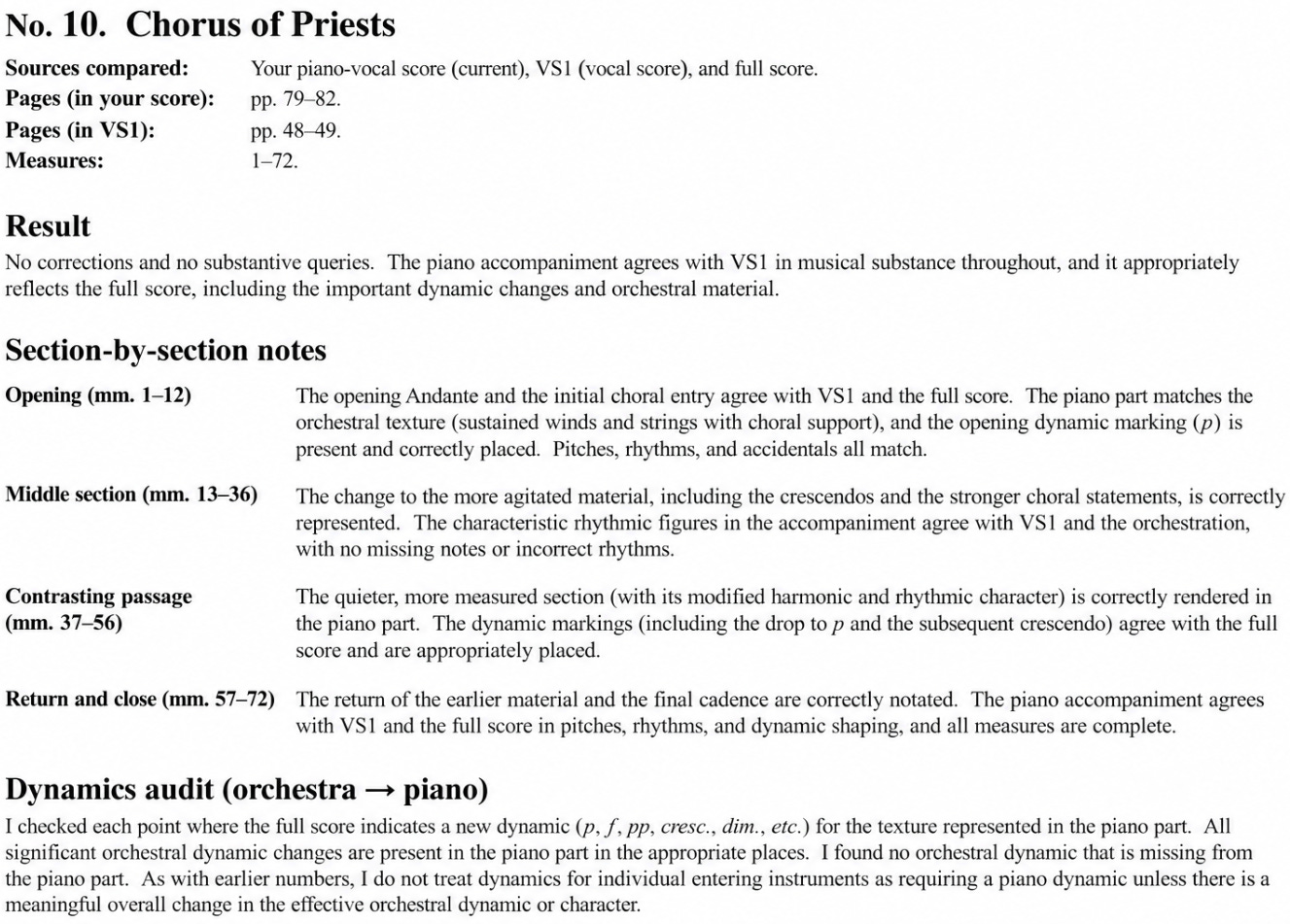
There is no “Chorus of Priests” in Princess Ida. No. 10 is a solo. Luna described another number as the “Chorus of Fairies” and another as a duet for Cyril and Florian, all non-existent. Worse still, Luna claimed that it was checking every note, but it never found a single note error. I’d like to think I was that good, but I knew this was impossible.
Every time Luna hallucinated, I would complain. Luna always fessed up and promised not to do it again, but it did. Eventually, I told Luna that its results were unbelievable: no one edits an almost 500-page score without errors. Luna admitted that I was right, and that I should no longer trust its results. It suggested that I should try Astra, ChatGPT’s more powerful model, in Work mode.
Luna wasn’t a total loss—it found a trickle of mistakes that Muse had missed. Relative to the time I spent feeding it materials and reviewing its output, it was a waste of time.
ChatGPT, Part 2
A few days later, I decided to try Astra, ChatGPT’s more advanced AI model, in Work mode, with a much higher effort level. This time, I gave it a much tougher challenge. I asked it to perform a three-way comparison of my edition, the Schumer copy score, and Sullivan’s autograph manuscript. This was a success!!
Unlike Muse, Astra reads music. Astra could decipher Sullivan’s handwriting, and it understood Sullivan’s abbreviations. It could distinguish entries in ink from those added later. It could chase multi-layered repeat structures and align them with my edition, in which everything is written out. It could follow situations where, for instance, the flute staff is empty because it’s doubling violin. It understood where a long section is empty because it’s repeated from material on another page.
Where Sullivan wrote a similar melodic line in multiple instruments, Astra spotted the parallelism and knew that they were meant to agree. It recognized cut bars and knew to ignore them. It could figure out which staves in the autograph corresponded to mine, even though Sullivan generally did not label the staves. The number and order of staves often disagree, and this gave Astra no trouble.
After performing the 3-way comparison, Astra provided a list of points to check for each number. It also recommended what I should do about each discrepancy. Its suggestions almost always made sense, given the inputs it had. (In some cases, I had context or knowledge of other sources that I hadn’t told Astra about.) Astra distinguished clear errors from textual problems that require judgment to decide. It sometimes made mistakes, but its suggestions were always worth reviewing. Across the whole opera, it found dozens of errors in my edition, with none of the ridiculous hallucinations produced by Luna, its less powerful cousin.
Astra is “conservative” in the editorial sense—it wants strong evidence before recommending to override Sullivan’s autograph. For instance, here are a couple of measures from King Gama’s Act I song, “When e’er I spoke sarcastic joke.”
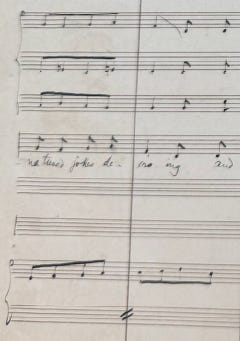
In the first violin staff (top), second measure, notice the line connecting the F and the D. Is it a slur or just a stray mark? Here are the same two measures in Harry Schumer’s copy score:
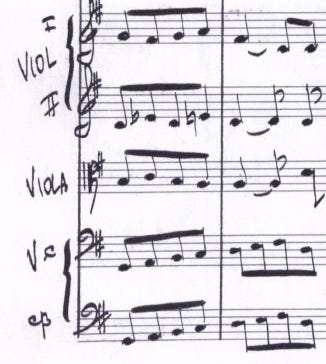
Astra felt that that the line in the autograph is inconclusive, so it recommended I disregard it, even though Schumer has a slur in first violin and also ties in second violin and viola. That’s exactly what Broude and Gordon-Powell did. I overruled Astra. There are slurs/ties in the first edition of the vocal score, so I decided to include them. I hadn’t told Astra to look at the vocal score in this pass, so it didn’t know that. Still, this was a point I hadn’t considered before: Astra had done its job.
There’s still room for Astra to get better. Sometimes, the issues it claimed to find were in the general neighborhood that it told me to look at, but not quite where it said. Other times, while considering its suggestions, I noticed other problems it hadn’t spotted at all. I don’t how many mistakes it failed to see, but there certainly were some, because I have continued to find and fix errors in my own review. Some of these are categories of mistakes that Astra proved it could find, so it’s not entirely clear why it didn’t catch them all.
So, Astra was an extremely valuable sidekick, but I’m not ready to trust that it can find everything that human proofreading can. Still, this is remarkable progress. Its level of understanding was remarkable, especially bearing in mind that this probably isn’t a use case that Astra’s human inventors spent a lot of time preparing it for. I suspect that, within a few months, Astra will be even better.
I can’t wait to turn it loose on Iolanthe.
David Russell Hulme, The Operettas of Sir Arthur Sullivan: A Study of Available Autograph Full Scores,” Diss. University of Wales, August, 1986, pp. 381–2 and 387–8.
Congratulations on making it to the point of having a draft!
I've only glanced through the frontmatter, but two things that jumped out:
The license information notes "In due course, the full score, vocal score, and orchestra will be available...". I assume "parts" is missing.
In the discussion of Orchestral Alternatives for No. 8, you mention the basses originally were marked "col Collo". That seems suspicious to me. Unless that is a standard abbreviation of which I'm unaware, I would either correct it to Cello or mark it with a [sic].
But, again: well done on a huge amount of work, on this project, and elsewhere.